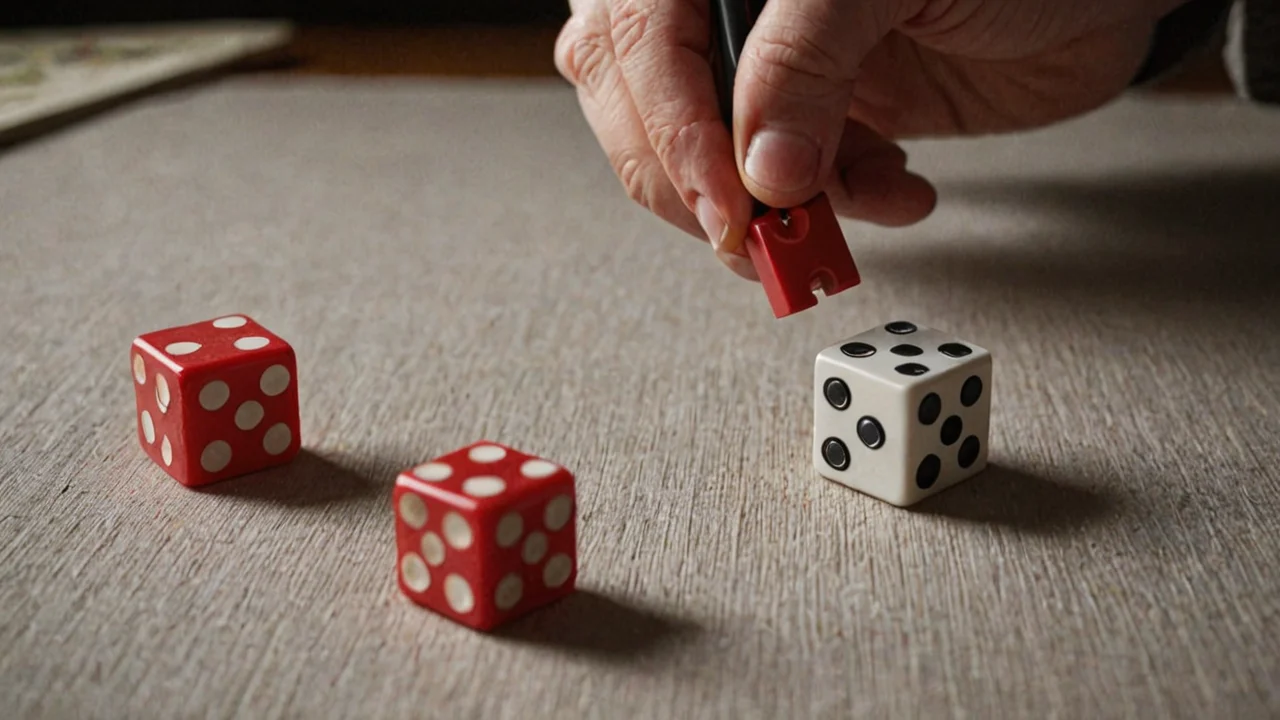
Puzzle strategy is the discipline of converting uncertainty into forced moves: you solve faster and more reliably by ranking which cells, candidates, or lines you can prove something about, and by refusing to guess until the puzzle's structure leaves you no alternative. Everything below is that idea applied — first to logic puzzles like Sudoku, then to word and deduction puzzles, then to the physical and mechanical puzzles where the "move" costs something you can't take back.
How constraint propagation actually works, and why it beats scanning
A standard Sudoku is a 9×9 grid of 81 cells, divided by thicker lines into nine 3×3 boxes, and the solution requires every row, every column, and every box to contain the digits 1 through 9 exactly once. That's the whole rule set. The strategy is entirely about what that rule set lets you conclude without looking at the rest of the grid.
The core mechanism is constraint propagation: every digit you place removes that digit as a candidate from every other cell in its row, its column, and its box. A single placement therefore eliminates candidates in up to twenty other cells. Strong solvers run this in one direction only — placements first, candidate lists second, and never the reverse. Beginners do it backwards. They pencil in a long list of possible digits in a cell and then stare at it hoping for inspiration, when the productive move was to place a digit somewhere else and let the elimination do the work for them.
What this looks like in practice: you scan for a digit that's already well represented on the board, check each box that lacks it, and ask which cells in that box are blocked by the digit's position in the corresponding row and column. When only one cell survives, you place it. That's a hidden single, and on most published puzzles it will carry you through the opening third of the grid without a single note written. Only when the easy placements dry up do you switch to candidate notation — and even then you write candidates for one unit at a time, not for the whole board.
The trade-off is real. Pure propagation is slow on hard puzzles and feels like grinding, because you're re-checking the same units repeatedly. Solvers who jump to advanced pattern recognition too early — X-Wings, swordfish, chains — often miss a trivial hidden single sitting in a box they haven't looked at since the start. The failure mode is unmistakable: you spend several minutes on an elaborate elimination and then discover the puzzle would have cracked with one more pass over the boxes. The cost of propagation-first is patience; the cost of pattern-first is time and error rate.
One honest limit: propagation alone cannot solve every valid puzzle. Puzzles that require guessing or deep chains exist, and no amount of disciplined scanning will produce a forced move on them. Knowing when you've exhausted the cheap techniques is itself a skill — and it's better to notice that after a systematic sweep than after twenty minutes of unfocused staring.
The order of techniques, and where each one stops paying
Work techniques in a fixed order and only escalate when the current tier produces nothing on a full pass. The order that costs least per unit of information is roughly: hidden singles, naked singles, locked candidates, pairs and triples, then the named fish patterns and chains. Each tier is more powerful and more expensive than the one below it, and skipping a tier is how puzzles get abandoned.
| Tier | What you're looking for | Cost | When it stops working |
|---|---|---|---|
| Hidden single | One cell in a unit that can take a given digit | Seconds per unit | Once every unit has a placement available and you've taken them all |
| Naked single | A cell with exactly one remaining candidate | Requires full candidate notation | When candidate lists are long everywhere |
| Locked candidates | A digit confined to one line within a box, or one box within a line | Moderate; needs clean notes | When no digit is confined anywhere |
| Pairs and triples | Two or three cells in a unit sharing exactly two or three candidates | Slower; easy to misread | On sparse grids with few bivalue cells |
| Fish and chains | Patterns spanning multiple rows and columns | Minutes; high error rate | Rarely needed outside the hardest tier |
The practical rule is that you should be able to state, out loud, why a placement is forced. If your reasoning is "this looks right," you're not solving, you're guessing with extra steps — and on a puzzle with a unique solution, a wrong guess propagates silently until it produces a contradiction several moves later, at which point you can't tell which of your last six placements was the bad one. That's the single most common way a solve falls apart.
Note what the grid geometry gives you for free: nine rows, nine columns, nine boxes, and every one of them is a unit with the same constraint. That symmetry means a technique that works on rows works identically on columns and boxes. When you're stuck, rotate your scan — if you've been working rows, sweep the boxes; if you've been working boxes, sweep the columns. It's the cheapest reset available and it costs nothing but a change of attention.
Notation: when to write, and how much
Write candidates only when single-technique scanning has stopped producing placements, and then write them for one unit at a time rather than filling the entire grid. Full-board notation on an easy puzzle is pure overhead — it triples your erasure work and introduces transcription errors that masquerade as logic errors.
The failure mode of over-notating is subtle. You write candidates in tiny marks, then place a digit and forget to erase it from three peer cells, and now your notes are lying to you. Every subsequent deduction built on those notes is unsound. Solvers who keep a clean board and add notes unit by unit catch this immediately, because there's less to be wrong. Solvers who fill the whole grid at the start often can't find the error at all and end up restarting.
There's a genuine trade-off in the other direction too. Some solvers refuse to write anything, treating notation as a crutch, and on hard puzzles that refusal caps them — the human working memory simply can't hold nine candidate sets across a unit while also comparing them. Notation isn't cheating; it's offloading. The discipline is deciding what to offload. Candidates, yes. Speculative placements, no.
Deduction puzzles: grids, marks, and the elimination habit
Logic-grid puzzles reward the same instinct as Sudoku but the bookkeeping matters more than the pattern recognition. The standard apparatus is a grid of categories along each axis and marks in the intersections — a check for confirmed, a dot or cross for eliminated — and the entire solve is eliminations rather than placements. You rarely get to assert that A is B; you get to assert that A cannot be any of eight other things, and the last one standing is the answer.
The habit that separates fast solvers here is reading each clue for its negative content first. "The person in the red house drinks tea" gives you one positive fact and a whole fan of eliminations: red is not any other drink, tea is not any other colour, and neither belongs to anyone else in the puzzle. Solvers who chase positives run out of steam halfway; solvers who harvest eliminations keep finding forced moves because the grid fills in from the edges.
Clue ordering is the other lever. Process clues that mention a category with few remaining possibilities first, because their eliminations bite hardest. A clue about a category where six options are already eliminated does almost nothing; the same clue early in the solve clears a swathe. Re-reading the clue list after every few placements is not inefficiency — clues that were uninformative at the start become decisive once the grid is half-eliminated, and the only way to catch that is to go back through them.
What goes wrong: marking a positive deduction without marking the corresponding eliminations. You conclude that Anna is the doctor and move on, leaving "doctor" available to two other people in your grid. Three clues later you derive a contradiction from a possibility you should have erased. The fix is mechanical — every time you write a positive, sweep the row and column for the eliminations it implies, immediately, before doing anything else.
Word puzzles and physical puzzles: different economics
In word puzzles — crosswords, cryptics, word ladders — strategy shifts from constraint satisfaction to retrieval and pattern-matching, and the highest-return habit is filling the grid in order of confidence rather than in order of position. Every filled answer seeds letters into crossing entries, and a single long answer can unblock four short ones. Solvers who work strictly left to right, top to bottom, spend most of their time staring at the one clue they can't get while three easy crossings sit untouched.
Cryptic clues have their own discipline: identify the definition first, then the wordplay, then reconcile. The definition almost always sits at the beginning or the end of the clue, and the surface reading is designed to mislead you into reading it as a coherent sentence when it's actually an instruction plus a definition. The failure mode is solving the wordplay, getting a plausible word, and never checking the definition — which is how you end up with an answer that fits the letters and is simply wrong.
Physical and mechanical puzzles have an economics all their own, because moves are not free. In a sliding-block puzzle, a twisty puzzle, or a disentanglement, the sequence matters and undoing a wrong move costs you the moves you spent getting there. The strategic principle is to plan the whole sequence before touching anything, and to work backwards from the solved state when the forward search is too wide. Reversible moves are cheap and worth experimenting with; irreversible ones — a fold, a cut, a lock that clicks — are not, and you should be able to say what you expect to learn before you commit to one.
The honest trade-off: planning costs time up front and is wasted on puzzles where the state space is small enough to brute-force. On a puzzle with a handful of possible moves, try things. On one with a wide branching factor, the plan is the whole game.
What practice actually changes, and what it doesn't
Deliberate practice on puzzles improves technique recognition and bookkeeping speed, not general reasoning power. The evidence base for puzzle training transferring to broad cognitive ability is thin, and the better-designed studies tend to find gains that stay close to the trained task. A large study of number puzzles including Sudoku in older adults assessed 14 cognitive measures in participants aged 50 to 93 years old, which gives a sense of how much ground such research has to cover to claim a general effect — and how carefully any single headline about "puzzles keeping your brain young" should be read.
What does improve, reliably and quickly, is your ability to see a hidden single without scanning for it, to notice that you've been ignoring the boxes for ten minutes, and to stop yourself from guessing. Those are all trainable and they're all technique. The way to train them is to solve puzzles slightly harder than the ones you find comfortable, at a pace where you can articulate your reasoning for each placement, and to review the solves that went wrong to find the specific point where the logic broke rather than the point where the contradiction surfaced.
The limits are worth stating plainly. Speed comes from pattern recognition built over many solves and it plateaus; accuracy comes from discipline and it doesn't have to. If you have to choose which to work on, work on accuracy, because a fast solver who guesses is slower than a careful one who never has to backtrack. And no technique saves you from a puzzle you've misread — check the given digits against the printed grid before you start, because a single mistranscribed digit makes a well-posed puzzle unsolvable and sends you hunting for a logic error that was never there.
The through-line across every puzzle type is the same: find the move that is forced, prove to yourself that it's forced, and only then commit. Everything else — notation, technique tiers, clue ordering, planning — is scaffolding for that one habit.